



Modern Discourse Analysis
About the Thesis
Credit goes to Dr. Jean de Dieu for supervision and to Assoc. Prof. Canisius for proofreading (University of Rwanda).
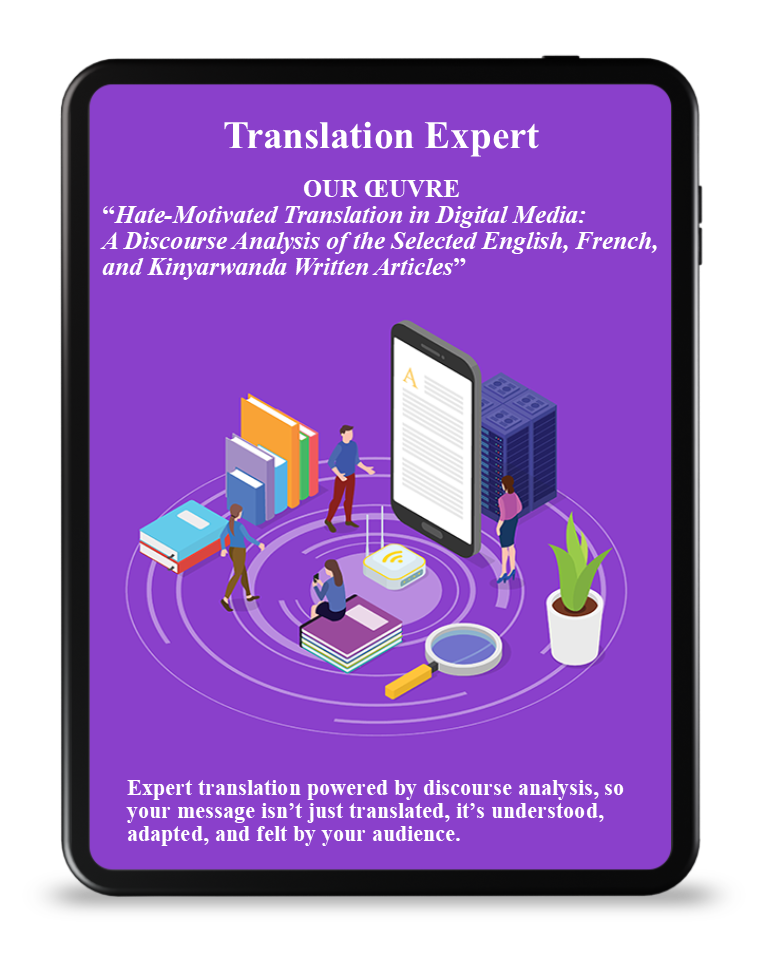
This study investigates translations intended to incite hatred in the multilingual coverage of presidential address, showing how English, French, and Kinyarwanda outlets reshape political speech into revisionism.
What's inside?
Preview at glance
Overview
This thesis overview is designed to present a discourse analysis study on multilingual media translation. It explores how language shapes meaning across contexts.
What is Hate-Motivated Translation? This study examines how some multilingual media coverage of presidential address reshaped political speech into hostile or revisionist narratives.
Discourse Analysis: Tracking Hidden Hate Across Translation
A sharp analytical lens that uncovers how meaning shifts across languages, revealing subtle distortions and exposing hate embedded within translation.
Chapter 1. General Introduction
This chapter establishes the study’s framework by situating it within post-genocide discourse and translation ethics. It identifies the core issue—ideologically driven distortion in translated media—and justifies its examination in light of political, ethical, and memorial implications.
It outlines the study’s objectives, research questions, and hypothesis, while highlighting its contribution to translation studies, media accountability, and genocide memory.
The chapter also defines key limitations, ensuring a realistic yet focused scope, before transitioning to the literature review.


If you need specialized discourse analysis for translation, you can reach out with your texts—whether media content, speeches, or documents—and request a tailored analytical service.
Chapter 2. Literature Review
Special thanks to Dr Joseph (University of Rwanda) for his invaluable guidance in sourcing rare and up-to-date discourse analysis documentation. Special thanks to Parliament Translators as well.
The literature review examines existing scholarship on translation, discourse analysis, and media representation. It identifies key theories and debates, highlighting how meaning can be shaped or distorted across languages.
It also reveals gaps in current research, positioning this study within ongoing academic discussions.
Tracking Hate Speech Through Discourse Analysis in Translation, Ever Vigilant
This approach uses discourse analysis to examine how translation can subtly reshape meaning across languages and media.
Chapter 3. Methodology
Data were collected using a corpus-informed qualitative approach based on 5 documented case studies across 7 media platforms.
The cases were selected through discourse-based sampling and theoretical saturation.
This chapter therefore lays the groundwork for a critical and empirically informed analysis of translation as a site of ideological struggle and discursive reengineering, setting the stage for the analytical tools applied to identify findings and interpretations presented in the chapters that follow.
Contact us to order discourse analysis in translation using a rigorous methodology to uncover bias, distortion, and hidden hate speech across multilingual texts with precision.
Chapter 4. Data, Analysis & Results
The analysis relied on Discourse Analysis (DA) and integrated tools from translation and memory studies to examine translations involving English, French, and Kinyarwanda.
Three original analytical tools were developed:
(1) Semantic-Tactical Mapping (STM), to detect ideological shifts between original and translated texts;
(2) Headline Reframing Index (HRI), to assess distortions in media headlines; and
(3) Terminological Integrity Grid (TIG) to assess terminological accuracy and identify terminological shifts between the source and target texts.
This research presents original analytical tools—STM, HRI, and TIG—for identifying translational manipulations.
We offer seminars to help clients researchers address translational manipulation using STM, HRI, and TIG to detect and correct distortions in multilingual texts.
Hire the Author
Martin, Translation Specialist (MA-level)
Exploring language, meaning, and translation with precision and passion.
Martin is a translation expert specializing in discourse-focused work. He transforms complex ideas into clear, culturally accurate communication, helping clients convey their messages with precision and purpose.
What people saying...
“LinguoMartini handled our translations with remarkable accuracy and professionalism.”
“Fast, reliable, and easy to work with — LinguoMartini truly understands multilingual communication.”
“Their interpretation services made our international meetings smooth and stress-free.”
Say hi and talk to us
Contact
Kigali, Rwanda
+250 786 145 053
info@linguomartini.com
Social
Copyright © 2026 LinguoMartini company
managed by M. Martin